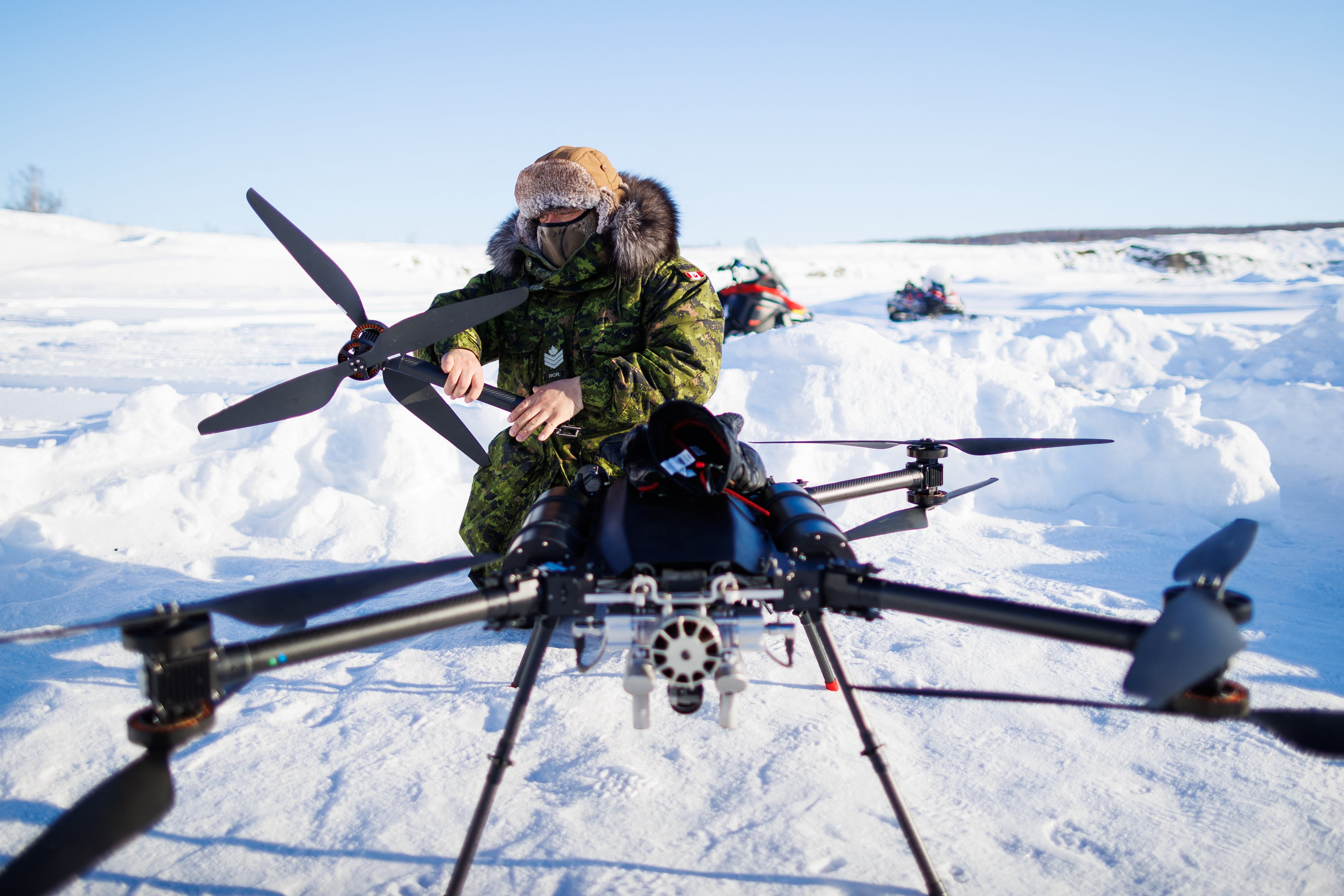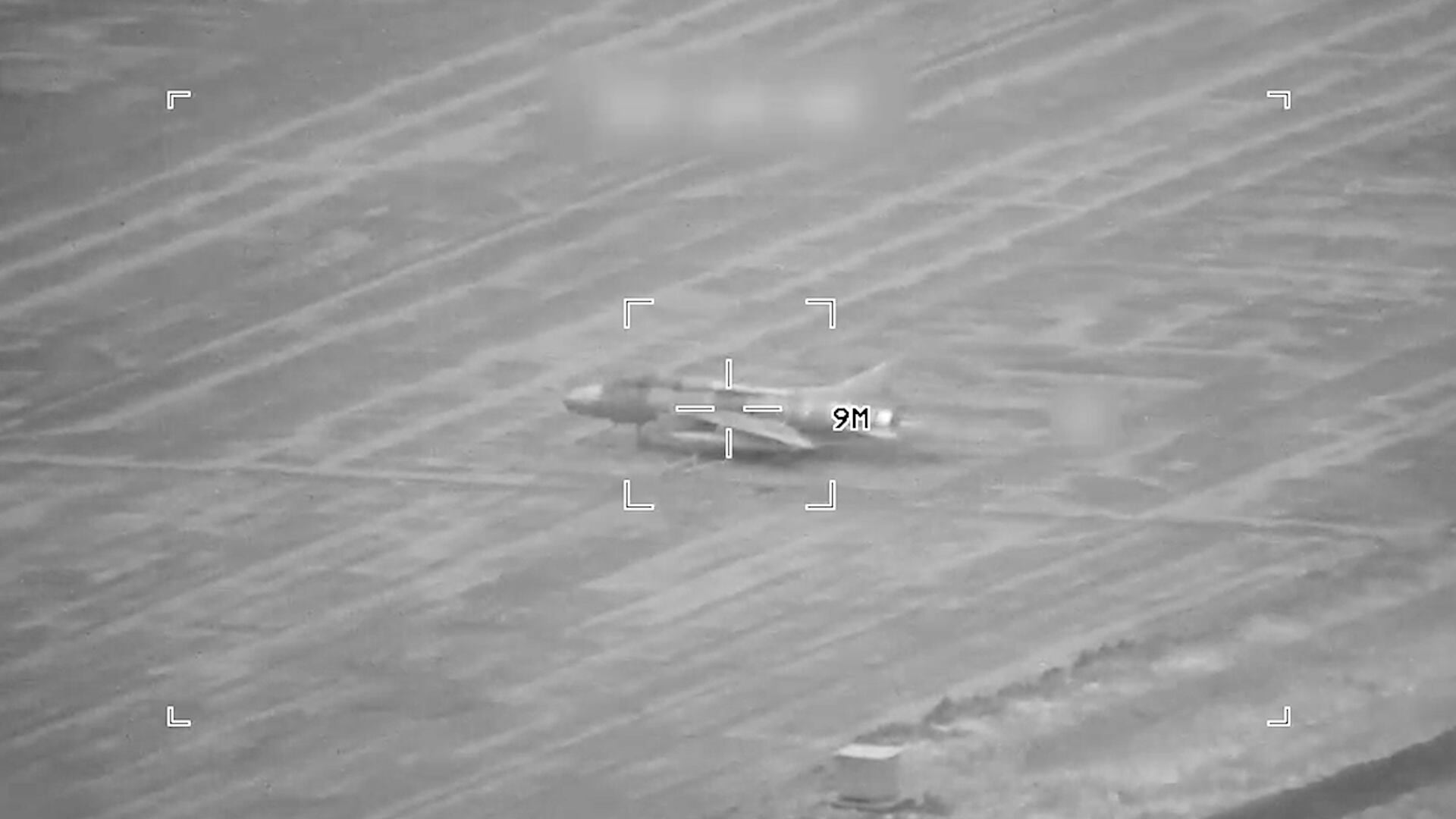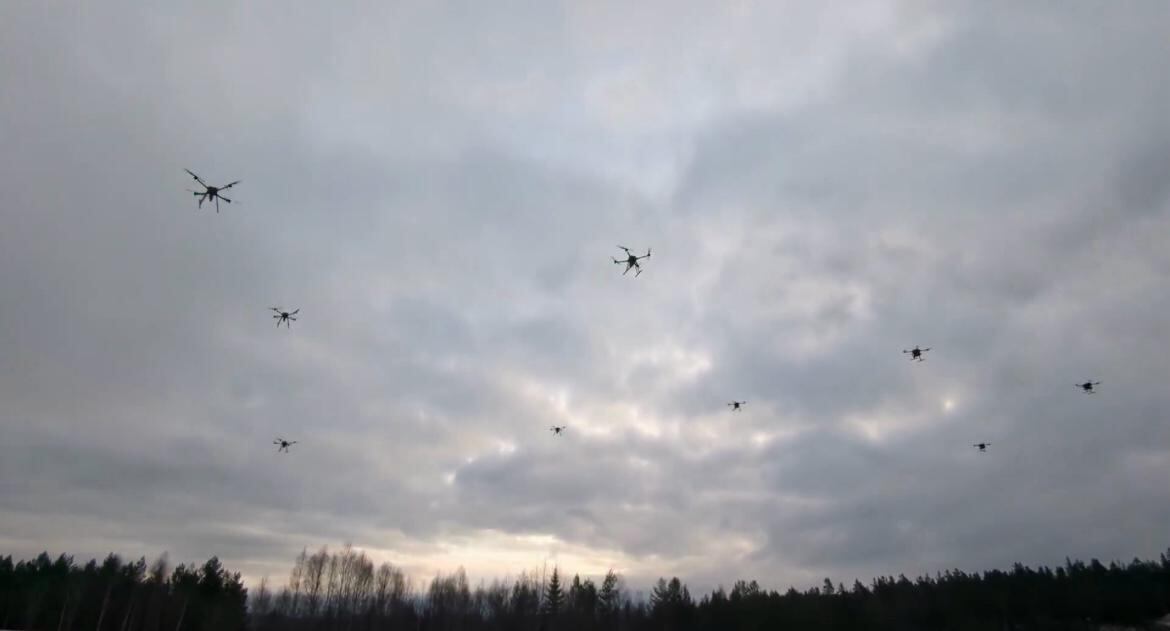
PARIS — Military units will start using drone swarms within the next two years as the underlying technology matures, according to the colonel in charge of exploring new defense technology and tactics for the French Army, as well as the Thales executive in charge of drone warfare.
“Within two years, we’ll indeed have real use cases deployed in certain units, and widespread adoption will quickly follow, because the benefits of these swarms will be quite obvious,” said Eric Lenseigne, vice president for drone warfare at defense firm Thales, speaking at the Forum Innovation Défense in Paris last week.
Drone swarms can circumvent two characteristics of today’s battlefield, access-denial strategies and the “hyper-lethality” of the frontline contact zone, said Col. Philippe Bignon, head of the Exploration Bureau at the French Army’s Future Combat Laboratory.
While several European NATO members are testing drone-swarm technology, and Ukraine has reportedly used small swarms of several drones on the battlefield, today’s unmanned systems typically still require a dedicated operator per unit. Swarm concepts envisage AI-enabled autonomous teams of drones that can sense, decide and act collectively with minimal human control.
Lenseigne said Thales experiments on swarm technology “show that we are on the verge” of having systems that will allow for true implementation of swarms, and he said all or almost all of the necessary technological building blocks for swarm use already exist.
Bignon said the first military capabilities will be available within two years, with more widespread rollout within five years.
France is working on the country’s first autonomous robot combat unit in the Pendragon project, combining land and air drones and AI-based command, with a first demonstration planned for 2026 and operational deployment the following year.
Swarms reduce risk by multiplying effectors, with only a few vectors in the drone swarm or pack able to accomplish the mission, according to Bignon. Artificial intelligence will allow the role of the swarm leader to be managed dynamically if the leader is lost, he said.
To circumvent access-denial strategies, Bignon described a scenario of “fairly complex swarm raids” combining suppression of enemy defenses, electromagnetic jamming, and attacks on communication and logistics supply lines and command nodes, which then allow for exploitation.
“There is a whole strategy for the use of swarms to be developed around penetration actions,” Bignon said. “This is undoubtedly one of the keys to breaking the tactical deadlock that we are seeing in Ukraine today.”
While new use cases for drones have emerged in Ukraine, the mode of operation has changed little for now, with pilots in most cases controlling a drone via a data link from beginning to end of a mission, according to Lenseigne.
“I don’t get the impression that this particular issue of swarms is progressing particularly quickly in Ukraine,” Lenseigne said. “In fact, what is striking in Ukraine is the very large number of drones that require a very large number of operators, and we are not seeing this capacity emerge.”
Though Ukraine is working on the technology, the country is not yet using swarms on a massive scale, according to Bignon. He said what will appear first is packs of five to 10 drones, which Ukrainians are working on, rather than swarms “in the sense that we might imagine them” of thousands of vectors.
Another use of swarms might be to resupply troops stuck in combat positions because of what Bignon called the hyper-lethality of the battlefield, with anything spotted moving near the frontline in Ukraine potentially destroyed within minutes. Swarms could also be used for deception maneuvers, the colonel said.
Swarms will accelerate the robotization and automation along the frontline in Ukraine, where there is already an area “where humans almost don’t intervene any more, only machines,” said Bignon. That will create a zone of “very high lethality” and “undoubtedly, the appearance of combat zones without humans,” he said.
Lenseigne said a future battlefield might be a place where “a rapidly dwindling number of inhabited platforms, highly sophisticated and very expensive, will coexist with an ever-increasing number of uninhabited objects that move around in swarms.”
One challenge will be ethical, because “swarms equal artificial intelligence,” according to Bignon. Operators will both have to understand possible deviations of AI and retrain their swarm system if necessary, as well as take responsibility, including legal, he said.
An underestimated aspect of swarms may be the psychological impact on soldiers who deploy them or face enemy swarms, Bignon said, comparing swarm warfare to the “dehumanized combat” some French troops have faced in the face of suicide commandos. “Obviously, in a dehumanized combat, there’s a sort of coldness behind it all that somewhat gives you goosebumps.”
The human factor could slow down the adoption of swarm technology, as people will have to adapt to “enormous changes in the way we approach combat, systems, and how we handle all of this,” said Lenseigne at Thales. “And that is something that man must fully integrate.”
Other potential obstacles to deploying hundreds or thousands of drones are the logistics required, as well as hardware integration, from packing drones in containers to figuring out how to power them until they’re sent on a mission, the executive said. There will be “a whole field that will have to be developed” to support swarms, according to Lenseigne.
“All these aspects seem trivial in terms of the difficulties compared to something like a highly intelligent system, but in reality, it’s hard, it’s physical,” Lenseigne said.
Rudy Ruitenberg is a Europe correspondent for Defense News. He started his career at Bloomberg News and has experience reporting on technology, commodity markets and politics.