MILAN – Sweden has allocated €1.4 billion ($1.6 billion) to establish multiple dispersed air defense units equipped with short-range air defense weapons to guard cities and critical infrastructure against aerial threats.
The announcement was made over the weekend during a presentation by the Swedish Minister of Defense, Pål Jonson, and follows a series of recent aerial intrusions across European strategic sites.
“The focus is on short-range air defense that can defend both civilian and military targets against cruise missiles and drones – the new territorial air defense needs to be simple and flexible, it should be possible to produce and maintain a number of units and to retrain soldiers who have been trained on other systems,” he said in a post on his X social media platform.
The plan entails several independent company-sized units that will be required to be mobile and modular to mix and match different weapons, including guns and radar systems. Assets requiring protection will include bridges, rail hubs, nuclear and hydroelectric power plants, as well as cities, according to a government press release.
Jonson stated that a first consolidated order will be placed with industry in the first quarter of this year, as the Swedish Armed Forces already conducted testing in 2025 of several systems “which can speed up the [adoption] process.”
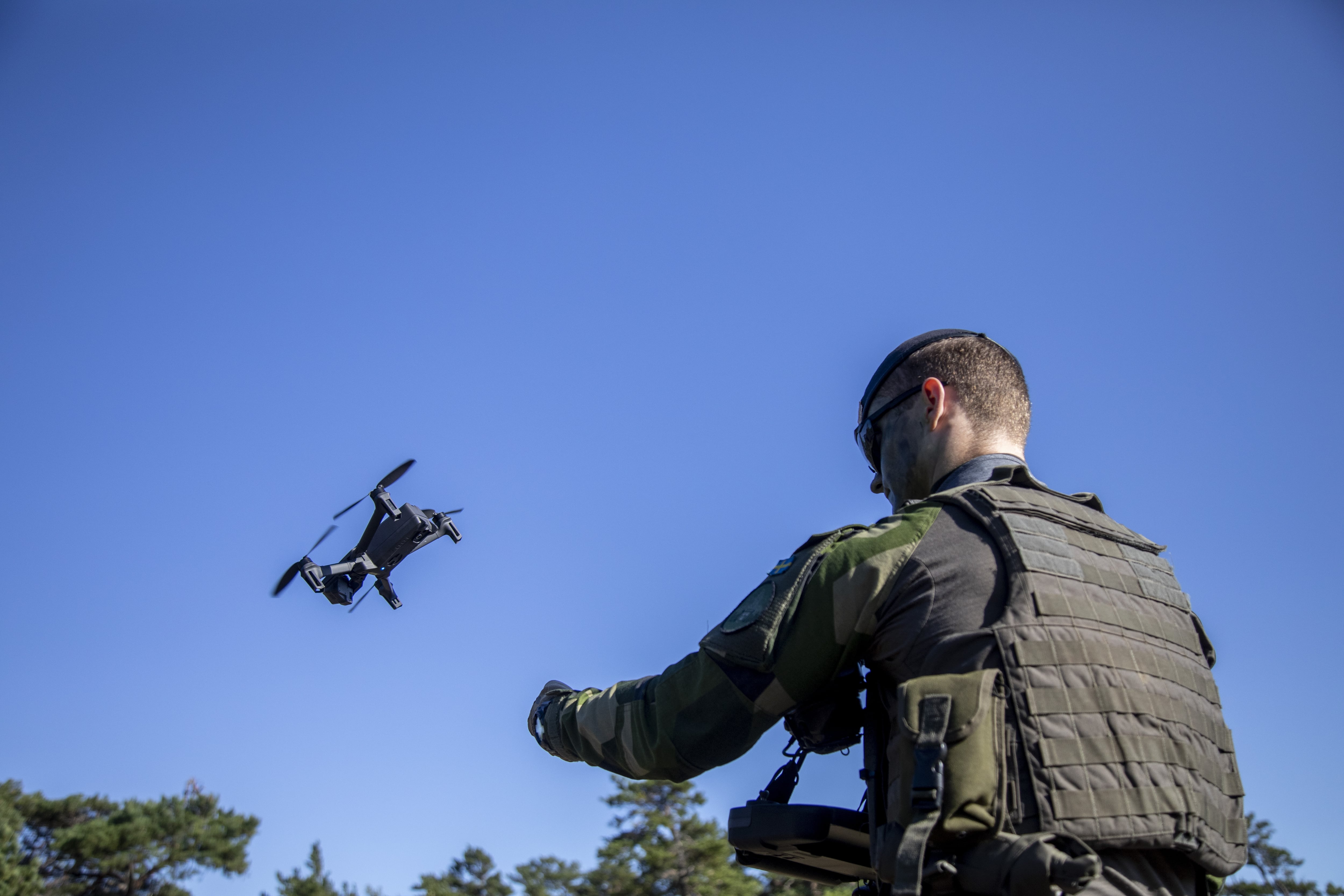
Sweden was among a list of European countries to have reported airspace breaches late last year by unidentified drones. In the fall, an unidentified unmanned aerial vehicle was observed close to Sweden’s Karlskrona archipelago in proximity to an important naval base, and suspicious drone activity was also recorded near the Gothenburg-Landvetter Airport.
In a recent interview with Defense News, Henriette H. Thygesen, the CEO of Danish aerospace manufacturer Terma Group, said that recent incursions have highlighted the speed of detection as a crucial gap in countering drones.
“It is not enough to just detect anymore – you need to validate quickly that it’s actually a drone, reduce false alarms, and act with more speed and confidence, that’s where sensor fusion and disciplined workflows make a difference,” she said.
While the Swedish government hasn’t publicized specific rules of engagement for the new units, it is expected that they will have the authority and equipment to engage hostile drones, including shooting them down if necessary.
Several European countries have recently adopted new laws granting their armed forces’ or security forces powers to neutralize drones violating national airspace, including Lithuania and Germany.
Additionally, the Swedish Armed Forces and Civil Defense Agency have been tasked to provide proposals for both active and passive protective measures that will be compiled next month.
Elisabeth Gosselin-Malo is a Europe correspondent for Defense News. She covers a wide range of topics related to military procurement and international security, and specializes in reporting on the aviation sector. She is based in Milan, Italy.