As the U.S. military examines future battlefield concepts against near-peer adversaries that have eroded the technological advantage, one aspect under discussion is how unmanned aerial systems, which have proven successive in permissive environments, will perform in future, contested environments.
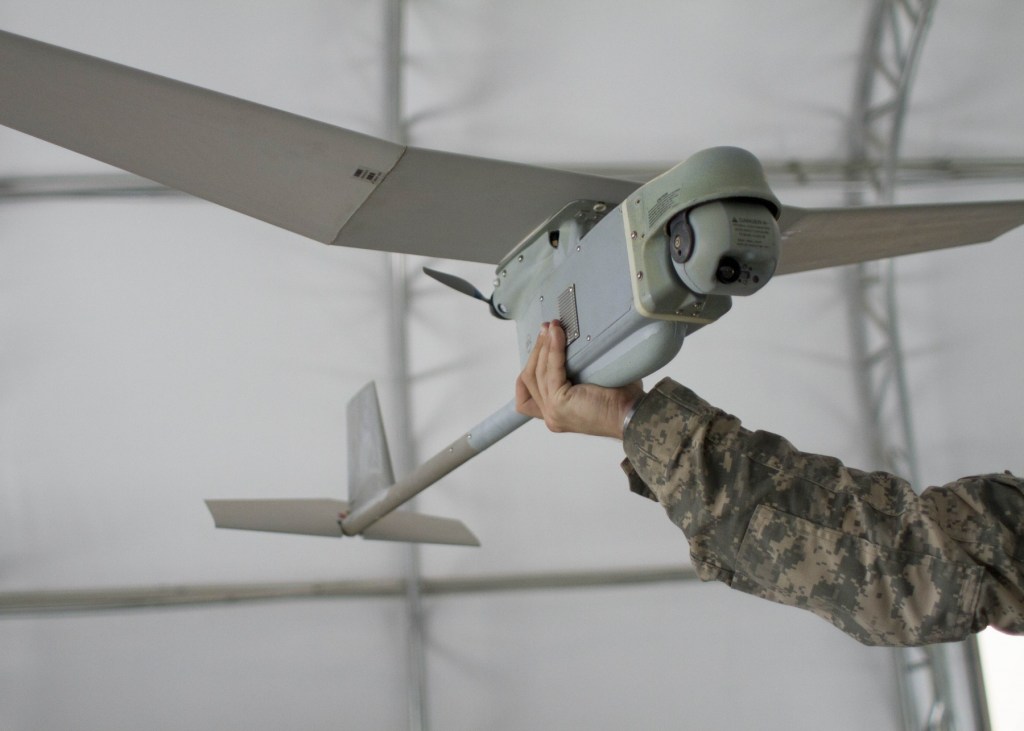
These systems, such as the MQ-1 Predator and the MQ-9 Reaper, are relatively slow-moving and highly susceptible to radar and anti-aircraft, which will likely be employed by these near-peer competitors. As the Air Force continues to evaluate both how these platforms will perform and what might come next after the MQ-9, one solution is to augment and relieve the stress of the Group 5 unmanned aircraft system (UAS) platforms with small UAS.
According to Col. Brandon Baker, the chief of the Air Force’s RPA capabilities division, the force will likely look to replace it with another Group 5, but instead of purchasing 500 of these platforms, the Air Force may buy 300 and in addition to purchasing 1,500 to 2,000 small UAS to accomplish the low end of the mission set — meaning predominately ISR mission sets,or counterterrorism mission sets conducted by Reapers.
Speaking Wednesday at the Unmanned Systems Defense conference in Arlington, Virginia, Baker small UAS could be a game changer in the service’s efforts to meet global demands. The Air Force released its small UAS plan in May; however, Baker said the plan is visionary and should not be read as a list of requirements, adding that the force has funds to dedicate to the testing of these systems.
“What I am talking about is how to move out of the tactical, non-networked that small UAS exist in today and project that globally as power projection for the U.S. Air Force,” he said. The current demands for global ISR from combatant commanders are unstainable, according to Baker, and small UAS, typically used in tactical situations, could be transitioned into more strategic and global concepts of operations similar to larger platforms such as the Reaper and the RQ-4 Global Hawk, a high-altitude, long-endurance ISR asset.
Brig. Gen. Brian Killough, director of strategy, concepts and assessments and the Air Force deputy chief of Staff for strategic plans and requirements, said at same conference that while he sees aerial combat involving these platforms in contested environments “within the realm of doable,” there should be a focus on the situational awareness capability of the platforms. He noted how F-35 pilots can look through the floor of their aircraft to see below, allowed by the various sensors on the aircraft, referencing that technology and capabilities are evolving.
A problem, he said, is the bandwidth and speed at which information travels so that the service can exercise solid command and control and avoid data latency and so pilots quickly receive information. “If you can’t react in a timely manner then you’ve lost the battle,” he said. These platforms are vulnerable in future, contested environments given the threat to communication links by hackers, he said.
While Killough noted the Reaper successor could be built with stealth capability, and that the force will look to add this to as many platforms as possible, he cautioned this will not be a panacea as for every measure, as there are countermeasures.
Describing how small UAS might be able to supplement these larger platforms, Baker outlined six major building blocks of where the force needs technological development in order to move out of the tactical environment where these small UAS typically operate and into strategic effects around the globe.
First, he described the need for intelligent airborne networks. When the force looks at concepts of operation that will make small UAS able to move into MQ-1 and MQ-9 mission sets, Baker said the service is moving from man-in-the-loop operations to man-on-the-loop operations — meaning our levels of autonomy and intelligence or cognition have to increase because they’re not going to be flying these airplanes.
Instead, “pilots” will be orchestrating the aircraft rather than flying them. “We’re not going to need pilots for small UAS, but we will need individuals that are air-minded, that understand airspace and application of air power,” he said, adding that the intelligent airborne networks are the connective tissue that will bring swarming concepts together.
Second, Baker described cognitive autonomy as a need to provide these small systems the ability to sense its environment, learn from its environment and make decisions. He said the service wants to avoid a situation in which an adversary defeats the network, causing aircraft to fail midair. Assuring his audience that he was not talking about Terminatoror kinetics — yet — he said he wants these cognitive, autonomous systems to have ISR, jamming, electronic warfare, electronic attack and other similar capabilities.
Third, he discussed the need for improved command and control for smaller systems, conceding that the force cannot operate small UAS the way it operates RPAs.
“We have ground control stations, very man-in-the-loop-centric, manual controls, rudder, or for Global Hawk, it’s a keyboard and mouse — but there’s a direct human and machine interaction,” he said. “What I’m talking about for the future is as we increase autonomy and intelligence [and] machines that will fly themselves, I need a way to orchestrate swarms or a loyal wingman that is independent of our common structures.”
In order to achieve this, he explained, he has reached out the Defense Innovation Unit Experimental (DIUx) for assistance. The problem he gave them, he said, he titled Ender’s Game, after the popular science fiction series. From Ender’s Game, Baker explained, there is a single individual that controls thousands of platforms at the wave of a hand. “I don’t think that’s too far-fetched for where we’re going,” he said, noting DIUx is working with the gaming industry and will work on a prevention that will be a combination of Ender’s Game and Minority Reportso the Air Force can command and control small UAS in the future.
Forth, the Air Force must develop capabilities to provide beyond line of sight communication, which is typically reserved for the most advanced platforms as they rely on satellite communication — reserved only for the most capable nation-state actors. As referenced above, small UAS have typically been used by small units in tactical environments with line of sight. If the force wants to move out of that localized, tactical environment, it must have strategic effects around the globe 24/7 just like any other modern Air Force platform, Baker said.
As antennas and satellites continue to develop, the Air Force anticipates it will be able to miniaturize, meaning it may one day be able to apply mass against an enemy, he explained, noting the advancements in miniaturizing satellite dishes aboard platforms to provide enough bandwidth for high-definition, full-motion video and other capabilities.
Fifth, in order to operate beyond line of sight or over the horizon, as Baker called it, these small platforms will need to have longer endurance and longer range. He described work on long-endurance propulsion, noting that the service is looking into different fuel cells such as solar.
Lastly, Baker said smaller systems will need to be recovered; however, there must be a multi-method launch-and-recovery system to make them effective. The force needs a way to deliver, recover and capture aircraft that is doable for every combatant commander. It can’t be a single mode of launch and recovery, he said — it must be multi-mode.
In terms of getting these assets to the battlefield, he does not see the service launching thousands of devices off the coast of California toward mainland China with today’s technology. What he does envision, however, is air delivery with ground or sea retrieval, or sea delivery with air retrieval.
Baker also provided examples of how small UAS could change resource allocation around the globe. Providing a brief vignette, he noted how the Air Force allocates RPA combat air patrols of around the globe. Certain theaters get more than others, he said. While the Reaper can provide a wide range of coverage in terms of area, combatant commanders might simultaneously want eyes on smaller areas that a single platform flying and covering a much larger area cannot reasonably patrol at the same time, he said.
A different way to offer force allocation, he postulated, is for the Air Force to allocate a swarm to a combatant commander. However, the Air Force would also have to develop the capability to disperse the swarm, he said, referencing the command and control technology needed from earlier in his presentation that will allow the same individual to disperse the swarm over the area of responsibility in many areas. These could be ground-launched or delivered midair from a C-130. With a central command and control node, they could address each individual area the commander needs, he said.
Additionally, swarms of small UAS could mass their effects to operate as a single platform, Baker said. Duplicating, or massing, sensor sets — using small UASs in a swarm to look at a high-value target from various angles — could increase positive identification, he said.
Taking this one step further, Baker outlined a self-healing concept. With the MQ-9, if it is shot down, the force loses that mission set and capabilities for good. The self-healing concept would be a prioritization schema provided to the swarm, which would allow the swarm to collaboratively understand who is involved in the fight and understand what sensors and payloads it has as a collective unit.
As some aircraft begin to attrit due to fire or technical failure, the swarm will regroup to continue its mission. It might not fully accomplish its objective, he said, but the swarm could still achieve part of it. It would not be a one-and-done situation as in the case of a shot down or malfunctioning MQ-9, he said.