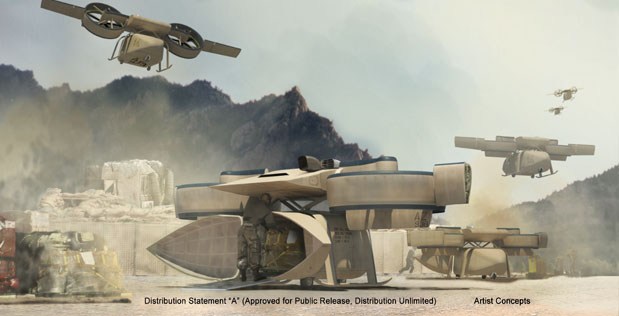
The platforms are still in development and consist of the Autonomous Aerial Cargo/Utility System, or AACUS, and the Aerial Reconfigurable Embedded System, or ARES.
AACUS is in development by the Office of Naval Research while ARES comes from the Defense Advanced Research Projects Agency.
ARES is capable of sending 3,000 pounds of gear for Marines in a single flight without sending out a heavy-lift CH53 helicopter – a switch that would save the Marine Corps fuel and manpower, said Roy Truba, deputy head for logistics strategy and vision sections at Headquarters Marine Corps, according to a Marine Corps Times report.
Both AACUS and ARES are still in the early stages of development and experimentation, but after continued testing the Marine Corps could move forward with a prototype in 2016 and deploy with an expeditionary unit in three to four years.