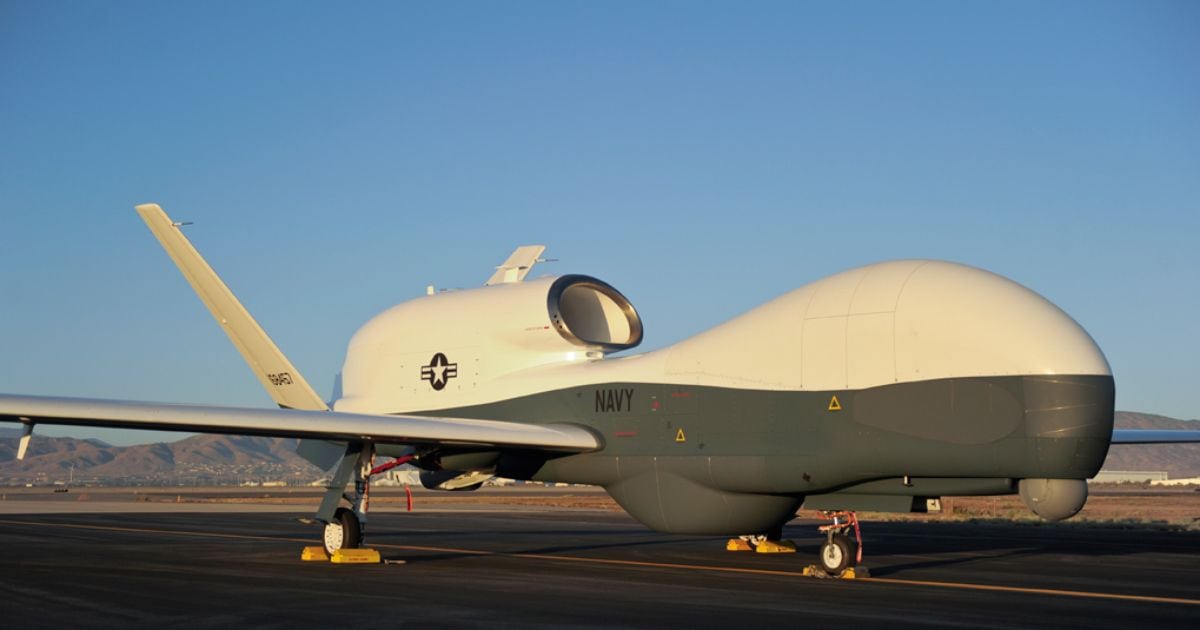
If the weather holds out, the Navy will be holding the first radar flight test of a new package of sensors for the MQ-4C Triton April 8Wednesday, testing out the new unmanned aerial vehicle slated to be the Navy's persistent presence in the sky.
The Navy Persistent Maritime Unmanned Aircraft Systems (PMA-262) program office got clearance Tuesday morning for the flight test, Principle Deputy Program Manager CDRCdr. Jason Rider announced during the C4ISR & Networks conference April 7.
The surveillance package is made up of four sets of sensors designed to give command a comprehensive view of the theater. The package includes an automated identification system, multifunction active sensors, electronic support measures and electro-optical infrared sensors.
"These sensors are not new, you'll recognize many of them," Rider said. "Putting them together in a package that has dwell time, persistence, like Triton, that is new."
Once active, the Triton UAV will act as a "persistent presence," flying extended surveillance missions and communicating and adapting as needed.
"Triton is the persistent arm" of the Navy's ISR systems, Rider said. "It is networked into a very mature and established worldwide data distribution system."
If all goes well with the test fight, the Navy is on track to make a decision on whether to purchase the MQ-4C Triton in the December time frame, Rider said.
"It is an exciting time in our program office right now," he said.
Aaron Boyd is an awarding-winning journalist currently serving as editor of Federal Times — a Washington, D.C. institution covering federal workforce and contracting for more than 50 years — and Fifth Domain — a news and information hub focused on cybersecurity and cyberwar from a civilian, military and international perspective.