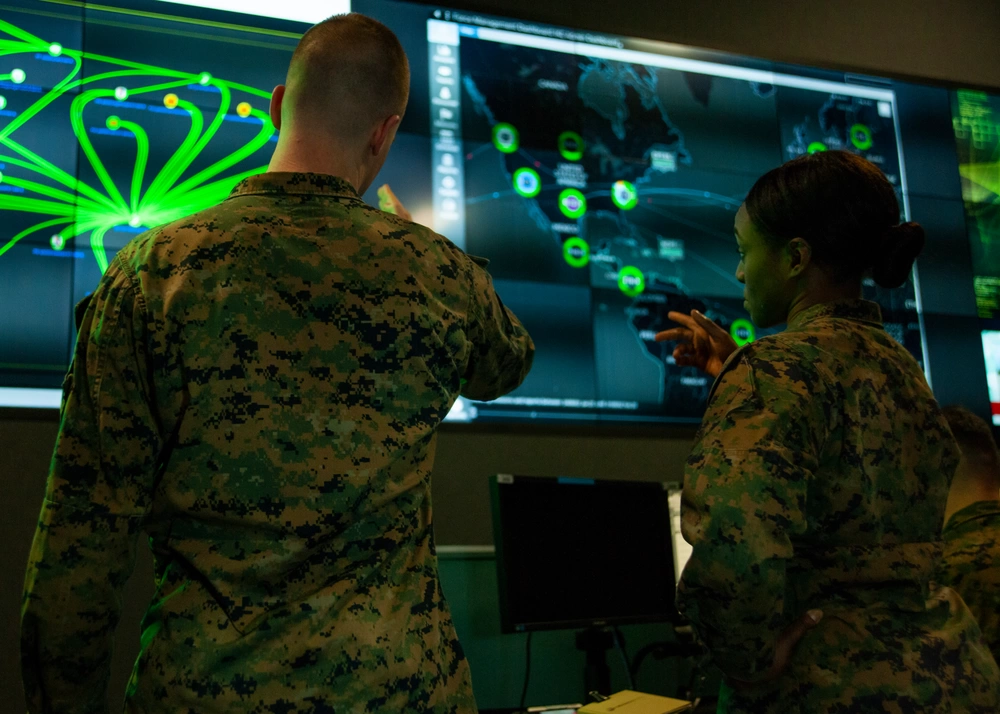
The U.S. military’s current cyber forces are “insufficient” to leverage the increase of cyber threats facing the nation, propelling the push by some policymakers to create an independent cyber branch, according to a report completed by two independent think tanks.
If lawmakers decided to move forward with the development of a U.S. Cyber Force, there would be challenges to its implementation because current responsibilities are shared between the various services and U.S. Cyber Command, per the Wednesday report written by the Center for Strategic and International Studies and the Foundation for Defense of Democracies.
“Many observers contend that the challenge of generating military capability and capacity necessary to deter, compete, fight and win in the cyber domain can be directly attributed to the lack of a single organization responsible and accountable for force generation in cyberspace — or organizing, training and equipping the military forces operating in this domain,” the report states.
Lawmakers have contemplated the necessity of a Cyber Force for over a decade since the 2010 establishment of U.S. Cyber Command, or CYBERCOM, one of the Department of Defense’s 11 unified combatant commands.
Current efforts to create a standalone Cyber Force are spearheaded by Sen. Kirsten Gillibrand, D-NY, as an amendment to the fiscal 2027 National Defense Authorization Act.
The report showcases how CYBERCOM is expected to perform the functions of both a combatant command and a military service, but a proposed Cyber Force would take over most of its “service-like” responsibilities, and thus organizing, training and equipping forces for the cyber domain.
The think tanks examined ways Congress and the Defense Department could stand up and implement a Cyber Force as a new military service with a cyber-specific mission that centers around assisting forces in conducting offensive and defense cyberspace operations.
The initial budget for standing up a Cyber Force is an estimated $10 billion to $11 billion, the report says, although that budget is already currently allocated into other services and cyber capabilities.
In the fiscal 2027 defense budget request, the Pentagon distributed $7.7 billion to cyberspace operations, according to budget documents, with $4.1 billion designated to CYBERCOM and the remaining $4.6 billion set aside for other defense organizations, such as the National Security Agency and the Defense Intelligence Agency.
The budget request also emphasized the need for $20.5 billion for cyberspace activities and $12.1 billion for cybersecurity.
At least 20,000 active-duty personnel, 3,500 to 5,000 National Guard members and a civilian workforce of 6,000 would be needed to staff a Cyber Force if established, the report reads, highlighting that the commission envisions the force as a relatively small military organization.
“By grouping personnel into broad occupational categories within which they can specialize or generalize, the Cyber Force will preserve distinct competencies, support future changes in how cyber missions are conducted and create a professional identity strong enough to anchor training, career development and long-term readiness,” the report says.
Instead of following the precedent of other military branches, the commission recommended that a Cyber Force follows in the footsteps of the U.S. Public Health Service by employing commissioned and warrant officers for uniformed personnel without an “enlisted cadre.”
The think tanks weighed two options for institutional alignment: placing the Cyber Force within the Department of the Army, like the Space Force is attached to the Department of the Air Force, or making the Cyber Force its own military department.
If included in the Army, the force could have increased speed and efficiency since it would belong to an already existing DoD bureaucracy, but it could be then considered a lower priority.
By having its own military department, the Cyber Force could ensure prioritization of cyber issues within the Pentagon, but standing up a new DoD bureaucracy would require substantial time and resources.
Regardless of organizational structure, it would take between 12 to 18 months to reach initial operating capacity, the report states.
Cristina Stassis is a reporter covering stories surrounding the defense industry, national security, military/veteran affairs and more. She previously worked as an editorial fellow for Defense News in 2024 where she assisted the newsroom in breaking news across Sightline Media Group.