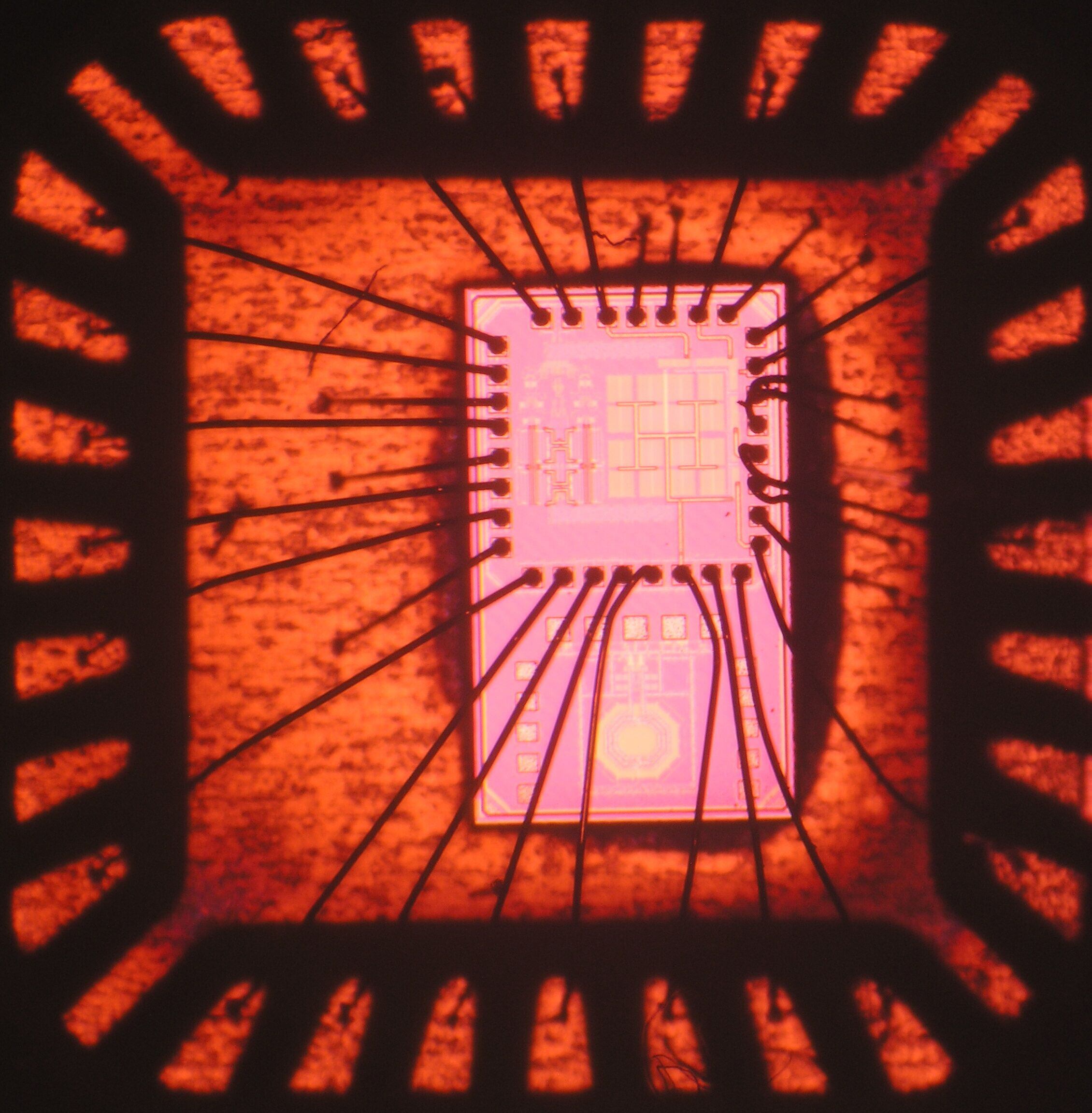
A DARPA-funded team has been able to produce electronic circuits that could double capacity for wireless communications.
Researchers at Columbia University, funded under DARPA's Arrays at Commercial Timescales (ACT) program, were able to make miniaturized circulators that ensure that radio frequency signals, in the form of electronic waves on the circuit, only travel in one direction, rather than two-way traffic that would cause interference.
Most materials allow two-way traffic, which in turn requires relatively bulky magnets to keep the signals going one way.
BONUS: Hear Jeremy Palmer, DARPA program manager in the Tactical Technology Office, speak on a panel about the military's approach to rapid provisioning of satellite bandwidth at a special C4ISRNet breakfast event April 27th. Mr. Winston Beauchamp, deputy undersecretary of the Air Force for Space, will keynote. Go here for more information.
"The Columbia researchers got around this roadblock to miniaturization by coming up with a path-breaking design that does away with the need for bulky ferrites and magnets," according to a DARPA news release. "Their design achieves the one-way RF flow with a series of capacitors coordinated with a minuscule and precise clock, electronically emulating the direction-dictating magnetic 'twist' that in conventional ferrite circulators is imposed on RF signals by an external magnetic field.
"That novel design makes possible an unprecedented microelectronic assemblage: A receiver connected to one 'on-ramp' (or port) of the new circulator structure; a transmitter connected to another port of that same circulator; and an antenna shared by those two tiny devices, itself coupled to the circulator via a third port situated between the other two. Since the RF propagation is one way (non-reciprocal) in the circulator, the transmitted and received signals smoothly traverse their respective paths without getting mixed up with one another."
Michael Peck is a correspondent for Defense News and a columnist for the Center for European Policy Analysis. He holds an M.A. in political science from Rutgers University. Find him on X at @Mipeck1. His email is mikedefense1@gmail.com.