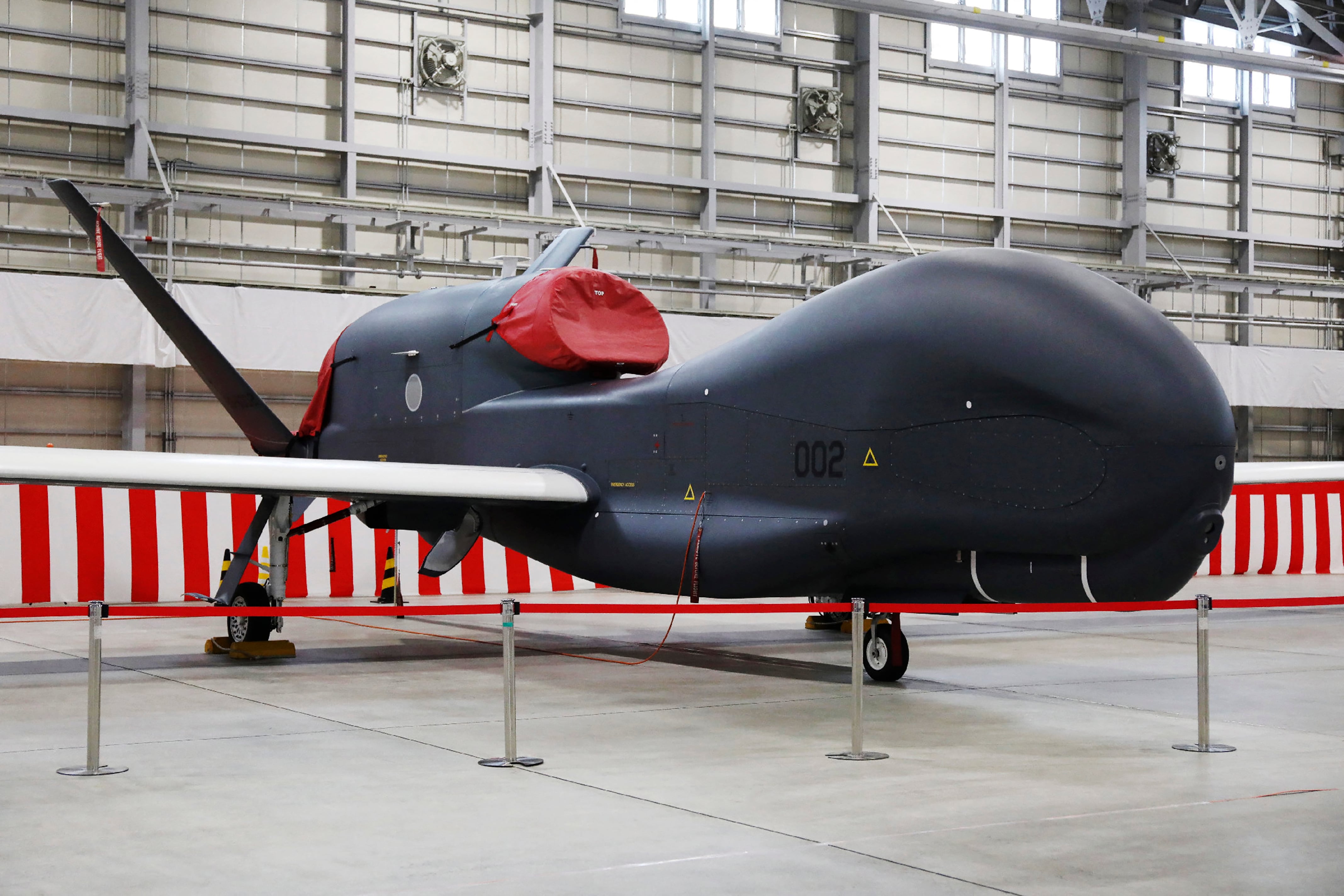
CHRISTCHURCH, New Zealand — A Japanese Global Hawk drone nosedived into the Sea of Japan on Sept. 15, instantly slashing the country’s fleet of these large-wingspan, unmanned surveillance aircraft by a third.
Japan paid roughly $163 million for Northrop Grumman to manufacture each of its three RQ-4B Block 30i Global Hawks nearly a decade ago.
The Japan Air Self-Defense Force (JASDF) on Sept. 16 revealed that it lost contact with the high-altitude drone at 12:55 p.m., before losing its radar signature three minutes later over international waters.
The JASDF’s 502nd Squadron operates its Global Hawks from Misawa Air Base in northern Japan. Before crashing, the drone had taken off at 10.20 a.m. on an unspecified mission, with JASDF Chief of Staff Gen. Takehiro Morita only divulging, “This particular flight was not a training exercise.”
One mission for Japanese Global Hawks, which can stay aloft for 32 hours at altitudes of up to 60,000 ft, is monitoring North Korean missile launch preparations. They are also useful for keeping an eye on Chinese military activities.
Morita said a Japan Coast Guard helicopter spotted debris in the water just 50 minutes after it had lost contact. Other assets spotted further wreckage and took photos, enabling precise identification of the aircraft.
No cause of the accident was revealed.
Japan received its first Global Hawk in March 2022, with the other two arriving later that year. Their integrated payload contains an electro-optic/infrared sensor, synthetic aperture radar and ground moving target indicator.
The Global Hawk purchase was controversial in Japan given their enormous cost and the fact that the U.S. retained tight control over the aircraft’s technology and the processing of gathered data.
Global Hawks possess the longest reach of any Japanese drone, so the loss of one among such a small fleet will be sorely missed.
However, as Japan increasingly prioritizes unmanned technologies, the Japan Maritime Self Defense Force is planning to induct the first of 23 MQ-9B SeaGuardians in 2027. Although these drones have a shorter endurance and range than the Global Hawk, Tokyo will use them for maritime domain awareness.
Japan’s draft 2027 defense budget requested US$1.88 billion for the first 17 SeaGuardians. These will take over some of the missions currently performed by P-1 and older P-3C Orion maritime patrol aircraft.
Incidentally, the U.S. Air Force currently has three RQ-4B Global Hawks stationed at Yokota Air Base in Tokyo, after relocating them from Guam in May to avoid the typhoon season.
The United States planned to quickly retire all its Global Hawks, but it will now keep operating them until 2033. After that, there will be only three in South Korea and two in Japan still flying.
Gordon Arthur is an Asia correspondent for Defense News. After a 20-year stint working in Hong Kong, he now resides in New Zealand. He has attended military exercises and defense exhibitions in about 20 countries around the Asia-Pacific region.