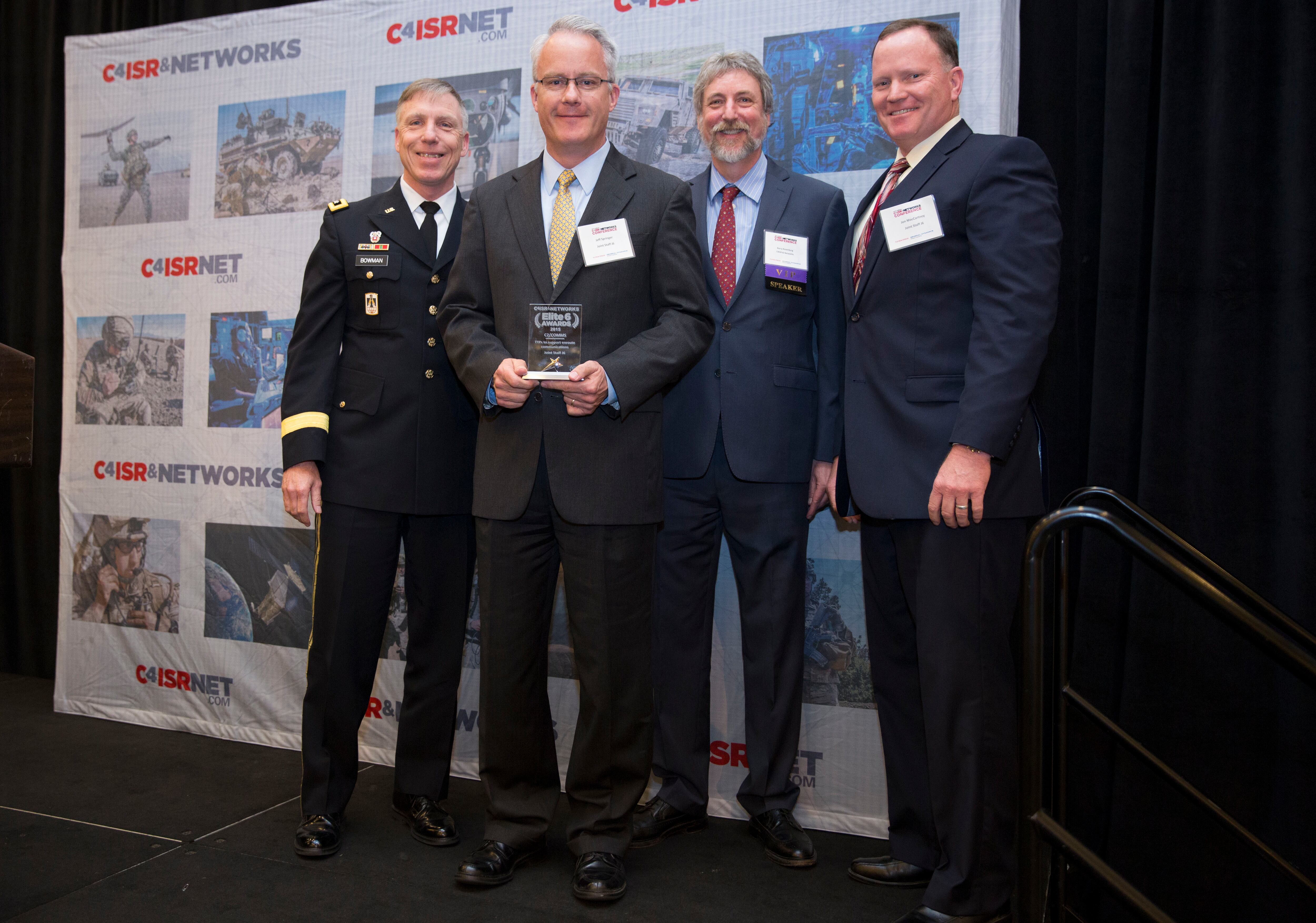
Top officials discussed a number of high-profile issues the Defense Department is juggling in cyber, cloud and intelligence at the 14th annual C4ISR & Networks Conference, held April 7 in Arlington, Virginia. The remarks shed light on existing issues and highlighted new announcements, including exclusive details related to new cyber initiatives unfolding at the Pentagon. The weaponization of cyber, launch of new guidance for cloud acquisition, development of new intel processing techniques and expansion of on-the-move Army communications all were key areas DoD officials discussed at the event.
See our complete coverage of the C4ISR & Networks Conference at our Show Reporter site.
DoD sets sights on weaponizing cyber
DoD appears to be preparing to make major moves in the military's cyber domain, with several components advancing their capabilities and policies, and the Defense secretary eyeing a specialized cyber corps.
At the Defense Information Systems Agency, the sweeping Joint Regional Security Stack initiative to overhaul IT infrastructure across military bases also is serving as means for DoD to empower troops to act in cyberspace. DISA is helping to implement JRSS at dozens of sites in the U.S. and abroad, but the agency also is changing the way it trains in and conducts cyber operations, starting at Fort Meade, Maryland, where DISA, U.S. Cyber Command and the National Security Agency all are housed.
"When you start looking at the command and control and the capabilities that we are going to put at the combatant commander's fingertips, not necessarily at the signal, communicator, cyber fingertips, we are getting ready to change the way we work," DISA Director Lt Gen Ronnie Hawkins said. "In fact within DISA, within the joint force headquarters, we are even training differently … I would tell you that we have to get it to where we treat the JRSS as a weapons system and we are operationalizing that within DISA and within the Department of Defense."
The same day, a top Navy official outlined a new strategy that will establish cyber as a weapons platform, including through the impending launch of 40 cyber mission teams that will deploy around the world, ashore and afloat. The teams will be part of the broader forces under CYBERCOM, of which each service has a component and provides support.
"The decisions around when to apply a [cyber offense] capability is at the CYBERCOM level," said Kevin Cooley, executive director and command information officer for Fleet Cyber Command/10th Fleet. "We're spending time making sure we're ready to execute should those options be considered appropriate by national command authority to do that. This is a warfare domain, so just like in other warfare domains we have the capability to be tactically offensive and tactically defensive [and] strategically offensive and strategically defensive."
The announcements come just weeks after Defense Secretary Ash Carter told a Fort Meade audience he is mulling the creation of a military cyber corps, rather than each service running its own cyber sub-component, and hinted at the possibility of elevating CYBERCOM to a combatant command. Both options are much-discussed subjects that remain open-ended.
Army pushes forward with new cloud policy
In line with broader DoD initiatives, the Army expects to soon release a new commercial cloud services provider policy that will outline service-specific acquisition requirements and provide further details about the Army's growing use of the commercial cloud.
"Transitioning to cloud-based solutions and services advances the Army's long-term objective to reduce our ownership, operation and sustainment of hardware and other commoditized information technology," Gary Wang, Army deputy CIO/G-6, wrote in an April 2 blog post. "Procuring these capabilities as services will allow the Army to focus resources more effectively to meet evolving mission needs" that will outline service-specific acquisition requirements and provide further details about the Army's growing use of the commercial cloud.
The forthcoming policy, which had not been released at press time, will accompany the CIO/G-6's new cloud computing strategy. The strategy outlines the service's evolving practices in IT modernization, providing users and potential vendors with a vision of how the Army plans to buy and use commercial IT, particularly cloud.
"The Army is changing its approach to modernizing IT infrastructure by moving to a cloud-based methodology," the strategy states. "This approach emphasizes reducing IT hardware procurements and sustainment in favor of procuring these capabilities as services from cloud service providers."
The strategy notes the Army's intent to implement modernization plans and develop new processes and procedures for maximizing commercial cloud services and IT as approved by DoD leadership. It also references how the new cloud policy will fit in with DoD-wide initiatives, including the Joint Information Environment and overall coalition operations around the world.
"Cloud infrastructure, people and processes will be central to enabling the Joint Information Environment," the strategy states. "The ability to connect to cloud capabilities assures availability, accessibility and security of Army computing and communications resources, authoritative data sources and information from the enterprise to the point of need."
The new Army guidance executes on evolving cloud policies at the Pentagon, where CIO Terry Halvorsen is overhauling the military's employment of commercial technologies.
"We are working within DoD to get better at our partnership opportunities," Halvorsen said of collaboration with industry, adding that he is regularly meeting with leadership from the various defense components to hammer out the path forward. "It has to be a supervised effort. It does need to be [all of] DoD and we have to get more enterprise-like in our behavior. And we are working toward that. There is some cultural change [and] there is some policy change that has to happen."
Army expands en-route communications
The Army is rolling out capabilities that will maintain soldiers' connectivity from home station, en route and into the theater, according to MG Daniel Hughes, Army program executive officer for command, control, communications-tactical.
"It's critical that we make that effort to make sure our soldiers can operate at home like they do in field," and vice versa, Hughes said. "The en-route mission command is something that's coming to fruition right now."
Those capabilities are being deployed on an ongoing basis, starting with 75 units that will receive an array of technologies to keep them connected, including elements of the command post computing environment, the mounted computing environment and the Joint Battle Command-Platform. That includes interfaces for displaying digital information and functions, such as logistics, intelligence and airspace management and maneuvers — that can be through radios, mapping applications, chat rooms and other capabilities.
"This will allow us to operate in the air as we move forward to the fight, keeping the same connectivity so you have information where you need it [and] when you need it as the commander makes decisions," Hughes said. "We have to have that ability to operate as the unit hits the ground so you don't have to build up," and so adversaries have less of a window for penetration during that buildup.
Intel community looks to life after TPED
The classic system for processing data and intelligence — tasking, processing, exploitation and dissemination, or TPED — is done.
TPED has been edged out by a high-tech intelligence enterprise that derives data from millions of sensors at machine speed, in addition to the digital power of connecting intelligence tools and sources. In TPED's place, however, won't be a single system or approach, but rather a comprehensive ethos that employs collaboration and open architecture to outsmart an increasingly savvy adversary.
"TPED is dead," said David Cacner, deputy director, National System for Geospatial-Intelligence Program Management Office and director of NSG Expeditionary Activities at the National Geospatial-Intelligence Agency. "What's dead about it is 'let's wait to collect and process and send it to my buffer and then exploit it.' No longer are we limited to a couple forms and sources; we've got multiple sources and we can't afford to wait. We need applications and algorithms to work on data, provide recommendations to us and then act on it, dig into it deeper."
More and more of those applications and algorithms are coming from entities other than the cash-strapped government agencies seeking them, according to Cacner and other panelists.
"We're adapting solutions," said Alan Mathis, deputy director of the Command & Control, Intelligence, Surveillance and Reconnaissance Division at Robins Air Force Base, Georgia. "We have worked with NGA, [the National Air and Space Intelligence Center], Special Operations Command, the Navy, the Army. We're working with labs to identify the best of what we can use and bring that into our program and take advantage of others' investments."
Cacner's words echoed those of NGA Director Robert Cardillo, who only a few weeks earlier also outlined the demise of TPED. It's a necessary casualty as NGA and the intelligence community become more reliant on commercial technologies and unclassified sources and data. ■