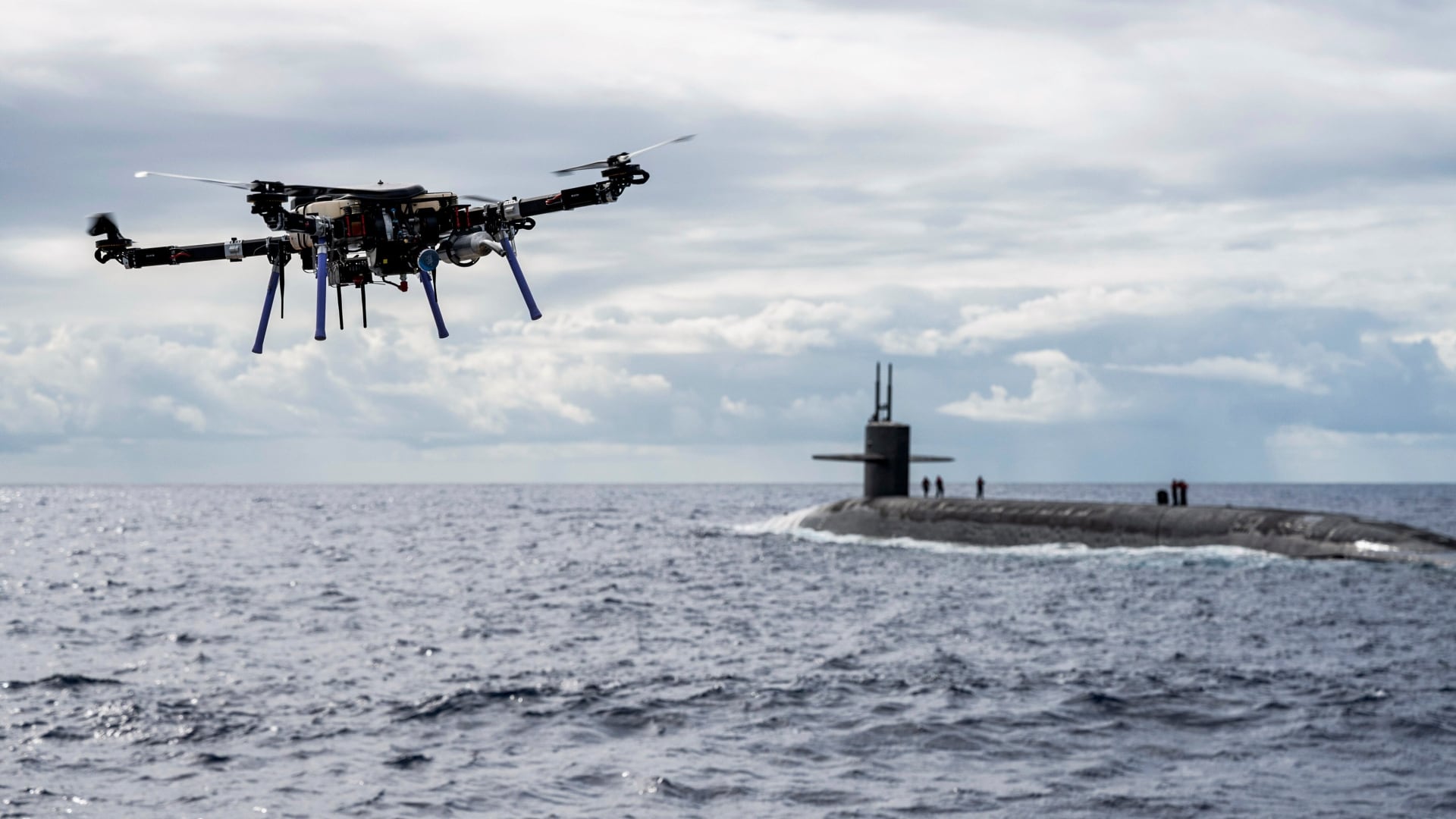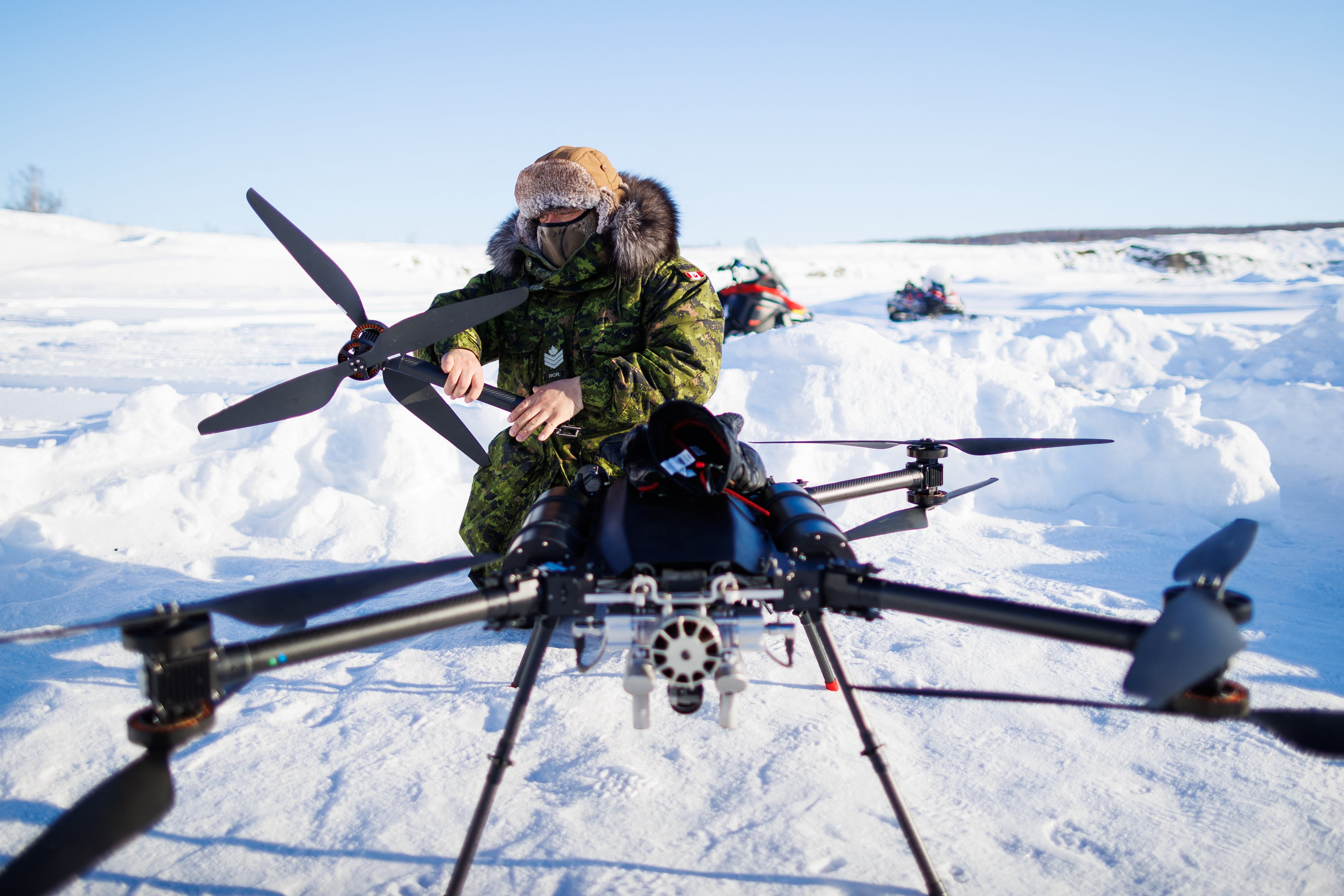
The alliance needs to close the drone gap with Russia in the High North — before it is too late.
Russia’s full-scale invasion of Ukraine has accelerated the return of high-intensity competition to the High North, a region that was perceived as a peripheral corner of global geopolitics for much of the post–Cold War era. As the United States and NATO Arctic allies hold intense debate about security throughout the region and begin to integrate drones for collective defense and deterrence, they face an uncomfortable reality: Russia is moving faster.
A growing gap has emerged between the alliance’s ambition to defend the High North and its ability to field Arctic-capable uncrewed systems at scale. The future of Arctic security will hinge not only on submarines, missiles, fighter jets and icebreakers, but on the capacity to deploy, sustain and counter uncrewed systems in extreme conditions and unprecedented numbers.
In this specific competition, Russia can leverage a significant edge. It fields the world’s largest industrial-scale drone ecosystem outside China and is institutionalizing combat lessons from Ukraine. Like Kyiv, Moscow has established a dedicated branch for uncrewed systems, expanded mass-training of drone operators, and is forming new drone units across the joint force, including within the Northern Fleet. It is also investing in Arctic-adapted platforms and command centers for long-range maritime drones. Annual production now exceeds 1.5 million units, with Western intelligence services expecting sharp increases driven by Chinese industrial support and sanctions evasion.
In the Arctic, Russia is likely to use drones as integrated force multipliers: enabling persistent ISR along Arctic littorals and the Northern Sea Route, cueing Bastion coastal defense systems, supporting anti-submarine and anti-surface operations and conducting long-range strikes with one-way attack drones alongside traditional missiles. These activities will be tightly coupled with aggressive cyber and electronic warfare to degrade allied sensing, targeting and command-and-control capabilities.
For NATO, uncrewed systems may matter more in the Arctic than in any other theater. Vast distances, sparse infrastructure and extreme weather constrain human presence and amplify gaps in domain awareness and response times. Traditional crewed platforms such as maritime patrol aircraft, submarines and ice-capable vessels remain essential but are limited in number and costly to sustain. Even with renewed investments, they cannot alone provide the persistent surveillance, logistics, and targeting required by NATO’s regional defense plans.
Drones help fill this gap. They can offer unmatched persistence, scalability, and flexibility at lower operational cost and risk to personnel, conducting a wide array of tasks, from reconnaissance and surveillance to logistic and resupply, casualty evacuation, mine and countermine operations, strike and more. In short, uncrewed systems are no longer niche enablers but indispensable elements for strengthening deterrence and defense in the Arctic.
Technology does not work in a vacuum
Procuring advanced platforms, however, does not automatically translate into usable capability. NATO faces structural challenges that limit its ability to exploit drones in the High North.
First, most systems are not designed for Arctic conditions. Extreme cold degrades batteries, icing affects propulsion and sensors, communications become unreliable, and corrosion accelerates wear. As a result, NATO suffers from a shortage of uncrewed systems certified for sustained cold-weather operations.
Second, infrastructure is sparse, complicating logistical support. Airfields, ports, and repair facilities are limited, while satellite coverage above 75°N is degraded and less reliable. Therefore, any robotization strategy must include adequate sustainment across the board. These challenges make reliance on autonomous features and GNSS-denied navigation essential, though the latter raises system complexity and costs.
Third, NATO’s problems are not only technical but also institutional and organizational. Doctrine, training, and innovation pathways have not kept pace with the rapid evolution of uncrewed technology and its military use.
Doctrine, personnel and other “unsexy” things
Despite recent updates, NATO doctrine still treats drones largely as supplements rather than as core elements of deterrence and defense. Commanders lack mature concepts for integrating uncrewed systems into multidomain operations against a drone-enabled adversary like Russia. The Arctic environment magnifies these gaps and demands greater efforts to develop shared approaches to human–machine teaming, standardized tactics, deployable sustainment, and counter-uncrewed systems operations.
Recent initiatives to support concept development, standardized training and operational experimentation are promising but insufficient.
Personnel challenges compound the problem. With many NATO allies struggling to recruit and retain people, the skilled operators, software specialists and specialized maintainers required for Arctic drone operations are in high demand but few in numbers.
Russia, by contrast, is rapidly expanding its training pipelines and embedding uncrewed expertise across its force structure. Autonomy can mitigate but not fully resolve the personnel problem. The human element and doctrine remain decisive to leverage the technological edge that uncrewed systems provide.
Innovation pathways across the alliance also remain slow and fragmented. While NATO experimentation initiatives are growing, they struggle to scale results. At the same time, private capital is beginning to play a larger role, with venture capital firms and European public–private mechanisms such as the European Defence Bank and European Investment Fund (EIF) increasingly backing uncrewed systems and AI startups.
However, as we explain in a recent report, harnessing this momentum will also require procurement reforms that favor speed, scale, and interoperability over risk-averse procurement programs and industrial protectionism.
A strategic imperative
For NATO as well as Arctic allies, the central question is whether they can absorb the institutional, organizational, and operational change required by large-scale robotization. The priorities are clear: field Arctic-ready uncrewed systems that are modular and interoperable by design; connect the battlespace through resilient command and control structures and high-bandwidth data pipelines; devise robust personnel and sustainment strategies and develop doctrinal tenets and concepts to effectively integrate uncrewed systems into the force structure and multidomain joint operations in an austere environment; and procure collectively and at scale, including through a mix of national and multilateral initiatives.
Without a strong demand signal for key platform categories such as tactical ISR drones, loitering munitions and uncrewed logistics vehicles, allies will continue paying premium prices for bespoke systems while Russia floods the region with battle-proven, mass-produced platforms.
These steps demand resources and urgency but also a solid understanding of what drones can and cannot do. Decision-makers need to move beyond the misleading quantity versus quality debate and focus on both elements, for uncrewed systems are neither silver bullets nor replacements for traditional lethality. Instead, their value lies in complementarity.
Effective Arctic defense requires a balanced high–low mix in which uncrewed systems extend and multiply the effectiveness of traditional forces rather than substitute for them.
Federico Borsari is a fellow with the Transatlantic Defense and Security program at the Center for European Policy Analysis (CEPA). He focuses on defense technology and military affairs.
Gordon B. “Skip” Davis Jr is a senior fellow with the Center for European Policy Analysis (CEPA), a retired U.S. Army major general, and former NATO deputy assistant secretary general for defense investment.