Advances in tactical robotics are changing operations on the battlefield and beyond, creating force enablers that will access previously off-limit locations or take on some of the world's most dangerous work. By interacting with humans and each other in new ways, the machines are altering the paradigm of autonomy.
Both the private sector and the government are driving innovation in the robotics fields. The Defense Advanced Research Projects Agency is running its DARPA Robotics Challenge (DRC) to create machines specifically for disaster response. In many response scenarios, officials have found conditions too dangerous for human activity. "There are often clear limitations to what humans can accomplish in the early stages and immediate aftermath of a natural or man-made disaster," said Gill Pratt, program manager for the DRC. The unpredictable nature of crises means developers cannot design and deploy specialized robots for each potential use case. The DRC therefore emphasizes adaptability and versatility.
RELATED:
Robots bring new abilities, new risks
"The type of robots we envision require four key capabilities to be effective: mobility and dexterity to maneuver in the degraded environments typical of disaster zones; the ability to manipulate and use a diverse assortment of tools designed for humans; the ability to be operated by humans who have had little to no robotics training; and partial autonomy in task-level decision-making based on operator commands and sensor inputs," Pratt said.
DARPA believes commercial investment is critical to lower costs and increased utility in the robotics field. "However, DARPA is taking a deliberately different research path than what we believe is being pursued commercially," Pratt said. "Our focus is on robots for disaster response in degraded environments, and that requires capabilities different than what are needed in the less austere, communications-friendly environments where most commercial robots would operate."
Opening the doors to innovation
Companies are doing much to advance autonomy in ways similar to and separate from military efforts. Boston Engineering is exploring diverse facets of the wide-ranging field, including: biologically inspired and high-maneuverability underwater vehicles; human-robot interfacing as it relates to robot team performance; unmanned ground vehicle (UGV) manipulators; and magnetic crawling vehicles.
Diving underwater, Boston Engineering is taking a biomimetic approach that enhances how the vehicles move. They can access or exit unconventional locations prohibitive to solid cylindrical forms. The biological inspiration also enables better battery life, maintaining efficiency at a variety of speeds, such as in open water, near piers or along a current.
The human-robot interfacing bases robotic interfaces on missions and operators' capabilities in certain situations. "[This research area] sounds a little heady and a little weird, because it is," said Mike Rufo, the director of Boston Engineering's Advanced Systems Group (ASG). In many cases, developers wait until the end of their processes to make decisions about control tools, reducing efficiency and effectiveness. By working on those capabilities early, Boston Engineering says it can have high-impact results on military users, reducing training time and enabling novices or experts to operate systems.
In the manipulator space, researchers focus on seemingly mundane tasks, such as opening doors. When most people open a door "we don't think anything about it, but there's quite a bit of cognition that goes on there," Rufo said. "It's a very hard thing to do with robots." His team is developing a vision system, electronics, autonomy capability and hardware to allow any robot to open a door.
The agnostic approach to systems gives it a wider user base. Work is funded by the Army, but other service branches, such as the Navy, are interested in this type of functionality. The ASG's efforts target the manipulator specifically to give it more than a single use. Instead of only opening a door, the manipulators under exploration at Boston Engineering will perform other tasks as well, removing humans even more from the loop. Through the work, the same gripper should open doors, move items and manipulate small objects, allowing the UGV to move around within buildings.
Helping autonomous rotocrafts take off
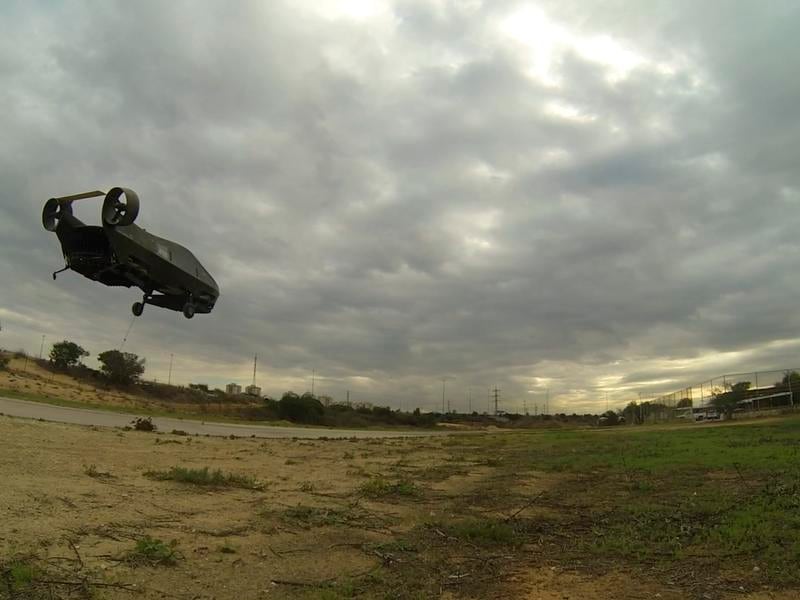
Flying tactical robots also are taking off in new directions. Urban Aeronautics, an Israeli company, is developing a compact, unmanned single-engine vertical take-off and landing aircraft with internal rotors called the AirMule. The features mean it can fly into obstructed areas, such as jungles or urban environments, and land on steep hillsides without concerns about rotor obstruction. As military operations move away from open-desert battlefields to more congested locations, maneuverability will become increasingly important.
AirMule can evacuate two casualties or reconfigure for other payloads. The vehicle can carry loads of 1,000 pounds or more, making it unique in its field. "There's nothing that's the size of a Humvee and can take off vertically with a 1,000-pound load," said Rafi Yoeli, president and chief executive officer of Urban Aeronautics.
Making these capabilities a practical reality has been a long road. Research on the concept began about 12 years ago. In December 2013, the first fully autonomous flight took place, and a full-fledged mission demonstration is slated for some time next year.
Developing a slate of control options
Other major advances in tactical robotics are being made in the areas of command-and-control for various purposes, including bomb disposal, unmanned convoys and reconnaissance. At iRobot, developers have created a controller called uPoint that functions similar to a universal remote control, but for ground robots instead of entertainment devices. With it, users can operate all iRobot UGVs through a tablet application, switching instantly between one robot and another.
Running on an Android system, the uPoint offers an open-architecture ability to integrate with larger cloud environments and provides enhanced communications capabilities. It features frequency agility within the bands it operates on, automatically seeking out least-congested frequencies. Less experienced users can enjoy those benefits automatically while experts could access deeper into the system to manually tailor communications options.
Robot teaming is important for many purposes and locations, such as non-line-of-site and urban environments. Eventually, systems will lose communications under such conditions. By working together, users can avoid those problems.
With uPoint, all the iRobot vehicles have similar, if not identical graphical user interfaces that reduce the time to reach proficiency, said Tim Trainer, vice president of robotic products at the company. They all talk on the same radio networks, playing into the idea of the family of systems. By reaching back into the cloud, uPoint can upload sensor data to command-and-control networks while simultaneously downloading specific mission data, training and maintenance tools. Trainer said iRobot fully expects that as the ecosystem of application-based programs grows, more third parties will release apps that can be leveraged by operators on the company's system.
One operator controlling multiple systems at the same time will rely on increased autonomy. By linking into the Android ecosystem, users can reach back into the cloud. With the offered cloud connectivity, autonomy should be enabled further, eventually offloading more operation of the system from the human. "We're not there yet," Trainer explains. "We're on the path to get there. We think the uPoint is a critical part of reaching that."